

The recently concluded 2026 World AI Conference delivered several important developments on AI safety: President Xi Jinping gave his most safety-forward speech to date, the official conference statement foregrounded cybersecurity risks, and the world’s first intergovernmental organization focused on AI was established.
WAIC is China’s flagship AI event, and since 2024, it has served as a central venue for China to set out its positions on global AI governance. This year was elevated further by President Xi Jinping attending in person for the first time.
Key takeaways
Xi’s first WAIC speech is his most safety-forward public statement on AI to date. Loss of control appeared in three separate passages, alongside warnings about AI misuse — a signal that both accident and misuse risk now register at the very top of the Chinese system.
The Conference Chair’s Statement contained the first reference to frontier model cybersecurity risks in a high-level Chinese government document since the announcement of Claude Mythos, alongside provisions on agent behavioral boundaries and joint prevention of terrorist misuse.
The newly established World AI Cooperation Organization (WAICO) is the world’s first intergovernmental body dedicated to AI. Its mandate centers on capacity building, and its 29 founding members are primarily Global South countries.
President Xi’s speech puts significant emphasis on safety and need for human oversight
Context: President Xi delivered WAIC’s opening speech (CN, EN). This is the first time China’s top leader has attended WAIC. It is also the most detailed speech Xi has ever delivered on AI in public.
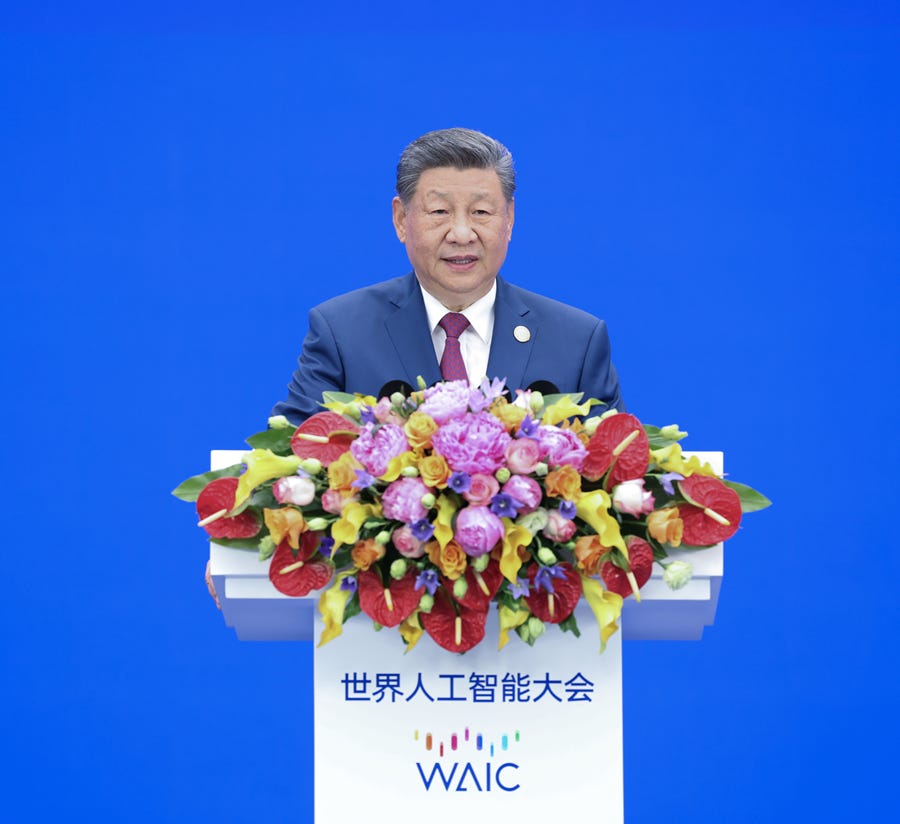
Content: Xi framed the speech around an “unprecedented period of active innovation on AI.” He compared AI to general-purpose technologies like the steam engine, electricity, and the internet, which enabled “giant leaps in economic and social development.” Notably, Xi focused on the application of AI across a wide range of sectors — including traditional industries like manufacturing — noting that AI “is moving from the digital world into the physical world.” In this context, he also emphasized the importance of open-source.
Noting that AI is “unleashing enormous power,” he posed four questions to the international community:
“How to get along with thinking machines? How to ensure security when algorithms are part of decision making? How to tackle ethical challenges by technologies through adaptive governance? How to realize AI for all when the divide keeps widening?”
The speech contains some of Xi’s starkest formulations on AI safety oversight to date. He said China places “great emphasis on safety and security in AI development,” and specifically:
Called for taking seriously the “various types of inherent and secondary risks that AI may trigger,” and for putting in place laws and regulations, technological monitoring, early warning, and emergency response systems.
Urged securing the “bottom line of safety” to prevent abuse and malicious use.
Warned that AI should be “always under human control,” and that oversight and governance must be “precise and effective,” with measures constantly refined “to forestall loss of control.”
He paired this with a call to oppose “overstretching the national security concept” in AI and placing one country’s security above others’.
On international governance, Xi’s focus was on bridging the global AI divide while also acknowledging the need for international governance:
On capacity building, he announced that over the next five years China will provide developing countries with 5,000 AI training and seminar opportunities, establish international AI application cooperation centers, and enable 30 countries to use MAZU, China’s AI-powered meteorological warning system.
He also underlined the important role of the United Nations, and called for alignment and coordination on development strategies, governance rules, and technical standards to produce a consensus-based global governance framework.
Implications: The broad contours of the speech are in line with previous policy signals: global equity through capacity building for the Global South, paired with risk management and safety oversight. His framing of AI as a general-purpose technology — and the focus on physical AI — reinforce that China’s approach to AI is anchored around raising productivity, especially in the “real economy.”
What stands out from a safety perspective is the repeated reference to loss of control, which recurs in three separate passages. This follows similar warnings of “technological loss of control” by Premier LI Qiang (李强) in June, suggesting it is now standard vocabulary for China’s top leadership. While there is some ambiguity about what the term precisely means, China’s leading AI standard-setting body has in the past linked it to “sudden, unexpected leaps in intelligence” enabling AI to autonomously acquire external resources, replicate itself, and develop self-awareness.
Xi also referenced misuse, suggesting concern both about humanity losing control of AI systems as such and about deliberate misuse by malicious actors.
Taken together, the safety content is more explicit than in any of Xi’s previous public remarks on AI, including at the April 2025 Politburo study session.
Chair’s Statement names specific frontier risks, including cybersecurity and terrorist misuse
Context: The conference issued a 15-point Chair’s Statement with extensive discussion of AI safety, including the cyber security implication of frontier models (CN, EN).
To the best of our understanding, a Chair’s Statement is issued by the host on its own authority. Unlike a joint declaration, it is not negotiated or adopted collectively by the 100-plus countries and organizations attending WAIC. The document is best read as a statement of the Chinese government’s position, not as evidence of international consensus.
Content: The statement mirrors many of the themes from Xi’s speech. But on safety, the content is even more specific, noting that:
Frontier AI poses potential threats to critical infrastructure in finance, electricity, telecommunications, and transportation. Leading AI companies should advance R&D with prudence, equip large language models with necessary guardrails, ensure safe deployment of frontier models, and guard against systemic risks (point 8).
AI agents must operate with clearly defined decision-making boundaries, mechanisms for behavior tracing, and risk alerts (point 9).
Countries should jointly prevent AI abuse by terrorist, extremist, and transnational criminal groups, with global crisis management and emergency response mechanisms (point 10).
Implications: The document goes into considerably more detail on specific safety risks than any official declaration released at WAIC in previous years, including the 2025 Global AI Governance Action Plan.
The reference to frontier model cybersecurity risks as a stand-alone point is especially notable. The topic has seen increasing global attention over the past weeks, as the US imposed export controls on Anthropic’s Fable 5 over a reported bypass of the models’ cyber safeguards. While several Chinese policy documents have acknowledged these risks in the past, this marks the first such statement since the release of Mythos. Together with point 10 on preventing terrorist misuse, this signals significant overlap in Chinese and international conceptions of misuse risks.
WAICO formally established, with a mandate centered on capacity building
Context: The Agreement establishing the World Artificial Intelligence Cooperation Organization (WAICO) was signed in Shanghai on July 16, the day before WAIC opened. Foreign Minister WANG Yi (王毅) signed for China, and UN Secretary-General António Guterres attended. 29 countries became founding members, though official Chinese sources name only five — Kazakhstan, Laos, Pakistan, Russia, and Indonesia. The National Development and Reform Commission (NDRC) and Ministry of Foreign Affairs (MFA) convened a follow-up meeting with signatories the next day to discuss the organization’s establishment and operation.
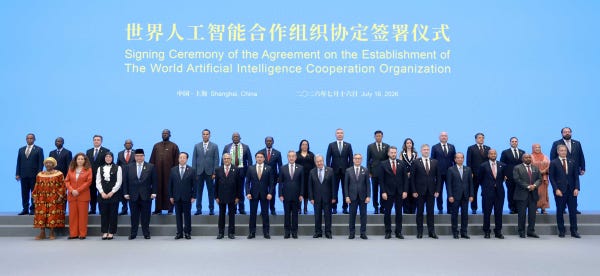
Mandate: According to Xinhua, WAICO will focus on three lines of work:
AI capacity building: improving access to AI technologies and services through policy exchange, technical cooperation, training, and joint research, so developing countries benefit equally.
A supply-demand matching platform: connecting members’ respective strengths, advancing “AI Plus” initiatives suited to national conditions, and encouraging joint construction of open-source ecosystems.
Support for the UN: defending the UN Charter, backing a stronger UN role, and implementing the Global Digital Compact and the SDGs.
Implications: WAICO is the world’s first intergovernmental organization dedicated to AI. It marks the clearest signal yet that China is positioning itself as an architect of multilateral AI governance. President Xi’s endorsement in his opening speech — describing WAICO as answering “the call of the Global South” and as “an important milestone in the history of AI development” — lends it considerable political weight.
The thematic focus is likely going to be on capacity building for countries in the Global South. The founding members are developing and emerging economies, with no G7 or EU member states signed up, though China said that WAICO is “open to all countries,” suggesting it may grow over time. One interesting thing to watch is how exactly China will coordinate its support for WAICO with its efforts to promote global AI governance at the UN.
Many details remain unconfirmed. The agreement signed on July 16 — which according to Xinhua covers the organization’s purposes, basic principles, functions, organizational structure, decision-making procedures and membership qualifications — has not been published.
Up next
Aside from those high-level developments, Concordia AI was also very active at WAIC: We hosted the Frontier and Agentic AI Safety Forum, organized several closed-door workshops, and released a series of new reports. More on that soon.
Thanks for the great writeup and linking both English and Chinese sources for the speech and statement.
Awesome coverage, as always!